
Gina Athanasiou MSc, MMus, MSc – Agronomist, Synelixis
For the viticulturist, few things are more encouraging than the first green shoots of spring emerging after winter dormancy. This delicate stage of vegetative growth marks the beginning of a new developmental cycle and carries the potential of the season’s crop. However, this period of renewal is also a period of great vulnerability. A single spring frost can erase months of work and compromise the productive potential of an entire growing season in just one night, particularly when it occurs after budbreak.
In vineyards across Greece, from the slopes of Nemea to the plains of Macedonia, the threat of frost is an annual reality. Understanding how frost develops is the first step toward moving from uncertainty and fear to proactive, informed management.
The two main types of frost
Advective frost
It forms when a large mass of cold air moves into an area, displacing warmer air. It is a large-scale meteorological phenomenon characterized by low temperatures, often accompanied by moderate to strong winds and cloud cover. Its defining feature is the horizontal movement of cold air. Because the entire air mass is below the freezing point, temperatures may remain low for prolonged periods, even during the day. This type of frost is particularly insidious because frost protection methods such as wind machines are often ineffective, since they cannot warm the air when the entire atmospheric column is cold. It is a severe weather event that challenges even the best-prepared growers.
Radiation frost
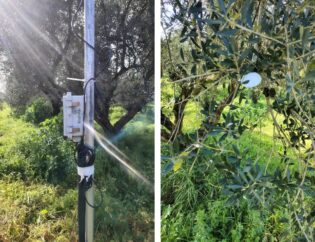
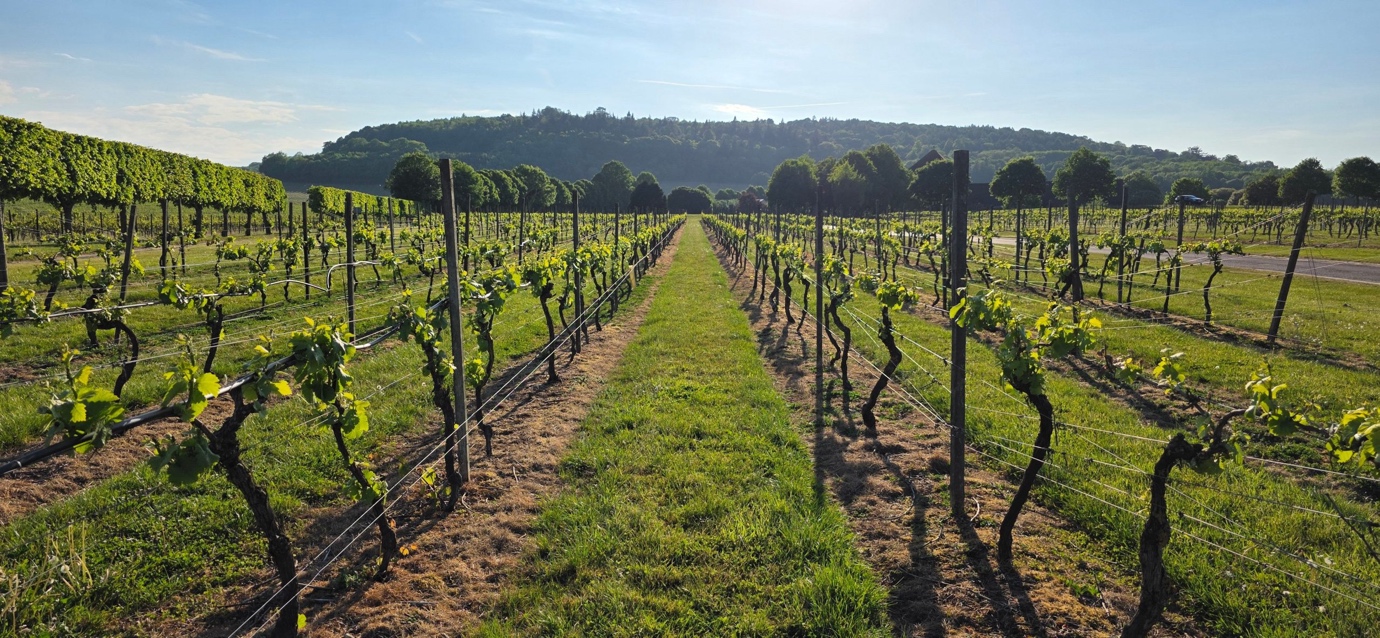
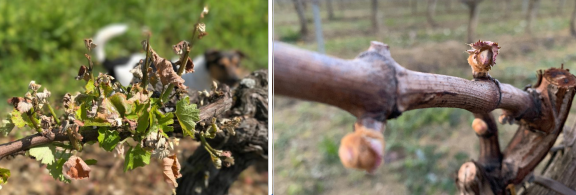
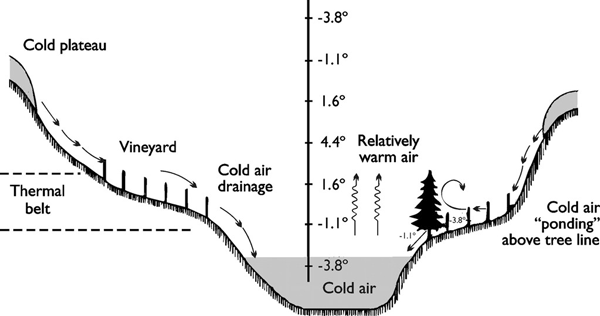
It is the most common form of frost. It usually occurs in open plains during calm, clear nights. During the day, the soil and plants absorb solar radiation. At night, they re-radiate this heat back into the atmosphere. On a cloudy night, this heat is trapped, but on a clear night it escapes into the upper atmosphere, causing rapid cooling of the soil and the layer of air directly above it. As the air cools, its density increases, causing it to sink and accumulate in lower-lying areas. This process creates a temperature inversion, in which the air a few meters above the ground is warmer than the air at vine level (Fig. 2). The sensitive primary buds and young shoots, trapped in this pool of subzero air, are the first to be injured (Fig. 1). This is the silent, localized type of frost that, with the right knowledge and the proper tools, growers can lean to manage.
Frost protection measures
Frost protection operates on two levels. The first is passive management, meaning all practices that reduce exposure or vulnerability before dangerous frost night occurs. The second is active protection, meaing the interventions applied during the frost event itself in order to keep the temperature of sensitive tissues within safer limits.
Under radiative frost conditions, passive measures can be particularly effective because the phenomenon is microclimatic. The most economical and effective form of protection is the one that does not need to be activated on the frost event itself. Careful vineyard site selection, avoidance of low-lying areas where cold air accumulates, selection of late-budding cultivars, training vines with a trunk height of at least 80 cm in areas prone to late frosts, appropriate row orientation, and the removal of barriers that obstruct cold air drainage and favour frost pockets can all significantly reduce risk. Delayed pruning, balanced fertilization, sound soil management, and proper weed management also play a much greater role than is often assumed.
Under advective frost conditions, passive management offers a smaller margin of protection, because cooling is widespread and wind enhances heat loss. In such cases, priority must be given to operational planning, system readiness, and the realistic selection of measures capable of functioning under windy conditions.
When frost is unavoidable, active protection measures come into play. Overhead sprinkler irrigation remains one of the most effective methods, provided that water availability is sufficient, operating pressure is stable, water application is uniform, and the system is properly designed. Compared with other frost protection systems, it can provide the greatest level of protection, down to about -7°C, at a reasonable cost, and does not pollute the environment. Its principle is thermodynamic: as water freezes on plant tissue, it releases latent heat, maintaining the temperature of the protected tissue close to 0°C and preventing damaging intracellular ice formation. However, its effectiveness depends on two factors that growers often underestimate: correct timing of system start-up and operational continuity. If started too late, tissues may already have reached temperatures at which injury begins. If stopped too early, while frost conditions still persist, ice formation and evaporative cooling can actually intensify damage. This is where a concept worth turning into practical knowledge becomes important: the dew point.
The dew point indicates how close the air is to saturation and, in essence, reflects the atmosphere’s tendency to evaporate water. The lower the dew point, the drier the air and the stronger the evaporative cooling may become when sprinkler irrigation begins. On dry nights, a sprinkler system may need to be activated earlier than on nights with higher humidity, precisely to avoid an initial thermal shock to plant tissues. Therefore, the decision to activate sprinkler irrigation should not be based on air temperature alone, but also on relative humidity and dew point.
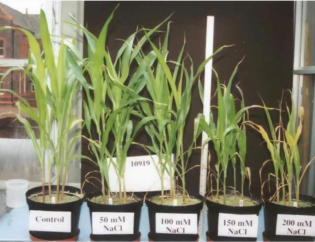
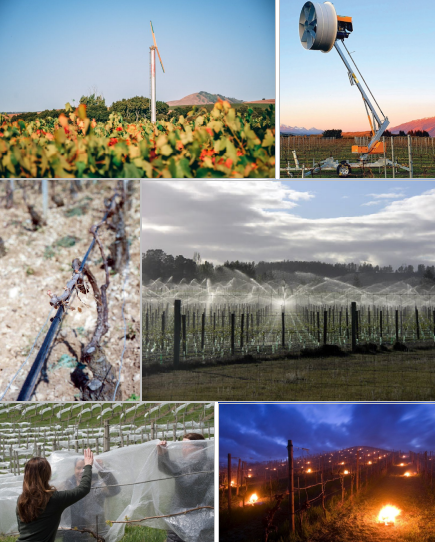
Other active measures include paraffin candles, which are widely used in Europe, although their cost is substantial, especially over large areas. Wind machines, heaters, thermo-protective fabrics, heated cables, and combinations of systems can also offer solutions, but they require investment, proper design, and good knowledge of local conditions (Fig.3). Each method has its own strengths and limitations in terms of effectiveness, cost, and the labour required for installation, operation, and maintenance.
SynField as a means of protection
Frost protection is often decided within minutes. Modern frost forecasting tools, combined with local measurements from within the vineyard itself, can make the difference between prevention and damage, especially when the grower must decide whether and when to activate protective measures. The greatest value of modern technologies lies in their ability to measure, quantify and interpret what cannot be seen and provide alerts when a cold night shifts from simple chill to a dangerous frost trajectory.
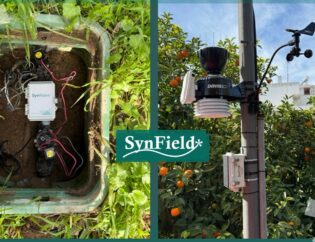
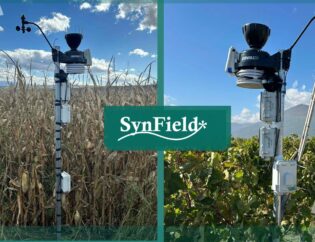
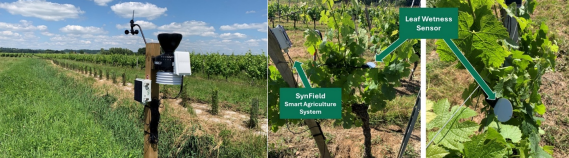
An advanced system such as SynField, strategically installed within the vineyard and equipped with advanced sensors positioned at vine height, provides a detailed, real-time picture of developing conditions by monitoring and continuously reporting on temperature, wind, relative humidity, and dew point (Fig.4). When the system detects that conditions are approaching the critical frost threshold, it sends immediate alerts to the farmer. This early warning allows the farmer to take action while there is still time.
Furthermore, this mechanism integrates seamlessly into management operations, such as the automatic activation of sprinkler systems and/or precision irrigation systems. With clear activation rules based on measurable and calculable parameters, the decision to irrigate becomes more reliable. The result is that protection is not delayed and is not based on estimates, assumptions, or weather forecasts, but on actual measurements of the microclimatic behavior of the specific vineyard.
Conclusion
Spring frost is not a new phenomenon. What is changing is the context in which it occurs. In an increasingly unpredictable climate, we are likely to continue seeing, as is already the case in many European wine-growing regions, more frequent episodes of premature dormancy release followed by cold spells and recurrent spring frost events.
Today, however, modern technologies allow us to transform frost from a source of fear into a measurable risk, and from a measurable risk into an informed management decision. In doing so, they help reduce losses and safeguard vineyard vigour, fruit quality, and productive performance. Above all, we should fisrt always remember that the best frost protection is still the one that begins long before the thermometer first drops to zero. No method is magical, and no method performs equally well under all conditions. As climatic challenges continue to evolve, so too do the technologies available to address them.